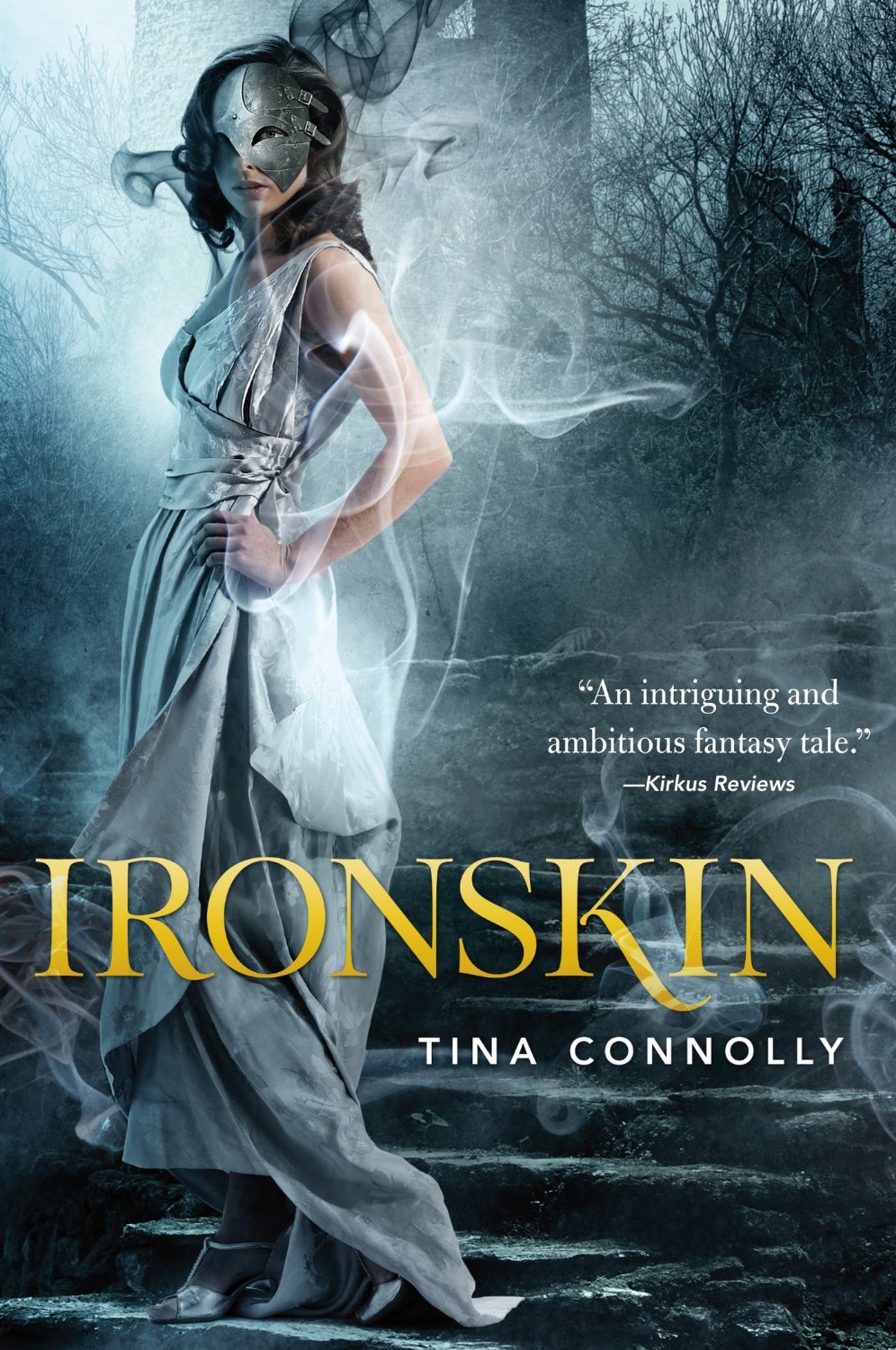
Review: Ironskin by Tina Connolly

Ironsking by Tina Connelly | A Review on ClearEyesFullShelves.com

At times I lazily select a book based on its title or cover with no specific expectation beyond a momentary “um, this looks interesting” thought. My reading of Tina Connolly’s Ironskin was one of these.

I simply thought,

“Heh… interesting title.”

I hadn’t read too far into the book before thinking it had a Jane Eyre quality to it. Admittedly, it’s been many, many years since I’ve read the classic Bronte novel, but there’s a distinct air, no pun intended, to the ambience of the book. So, I called Sarah and mentioned this very-astute observation, and then she informed me that Ironskin is indeed a steampunk retelling of the classic gothic tale.

Unfortunately, while I enjoyed reading Ironskin, I found the retelling a veneer that I discarded as superfluous and the steampunk elements rather pretentious and under-developed.

Like in the source material, Jane comes to work as a governess at a once-elegant house fallen into disrepair; there’s a strangely haunted and despairing man; an odd child; and they’re all waiting to reveal secrets that lie within, both literally and figuratively. 

Ironskin delves into the masks individuals wear to hide from themselves and others. Hiding from reality behind an iron mask to shield her from the power of the fey against whom humans suffered a devastating loss from in a recent war becomes a door to open and release truth and power. Jane’s mask, she comes to realize, is not unlike less obvious ones worn by others. Masks become a motif woven throughout the pages of the novel.

“Perhaps there are more masks like that than we think. A mask you cannot look through…your eyes sealed shut.”

Fey lived in comfortable compatibility with humans furnishing them with technology to power the machinery of their lives. Blue packs flitted from the forest, home of the Fey, into the hands and lives of humans who did not realize that there is a price for everything.

“The forest had a foothold it would not relinquish.”

WTF: GQ's "Reading Man's Guide to Dirty Books"

December 2012 GQ Cover - WTF: GQ's [Hey, Mom, you don’t need to read this piece, okay?]

The latest installment in the continuing chronicles of, “OMIGOD! Women are reading about S-E-X! The end of the world is nigh!” comes from in the form of GQ’s unfortunate (print-only) article by Tom Bissell, “A Reading Man’s Guide to Dirty Books.”
Bissell, identified by the magazine as a “connoisseur of the finest literary smut” (he’s actually a professor at Portland State and an expert in video games*), argues,

“The best way to seduce an intelligent woman? It’s shockingly simple, really. Read to her.”

Because, obviously, if the men in intelligent women’s lives aren’t selecting dirty books that said men will then read aloud to their lady friends, those women may make “bad” choices in “trashy” reading materials and who knows what might happen?

Oh, noes! Women may even read “trashy” novels written by women, which chronicle the female experience with a healthy, sex-positive, point-of-view on women’s sexuality. Gasp! 

Sarcasm aside, I think it’s interesting that Bissell advocates removing women from the equation and men literally reading to them “erotic” books written by men (and I’d argue for men) so they can understand and apparently be titillated by sex through the male gaze.

Bissell points specifically and banally to the Fifty Shades of Grey craze as a problematic sex-filled read (apparently, according to Bissell, there is a veritable a “litter” of sequels, not just two—someone tell E.L. James), arguing that the women of the world are picking up these novels for one (extremely sexist) reason. 

“It was then I realized why women across the Western world were firing up their vibrators at the thought of Christian Grey flogging the imbecilic Anastasia Steele. The story was the wand by which E.L. James had transformed the realm’s every mom-jeaned frump into a preciously violated princess. You could argue that we see the male equivalent of this dynamic all the time in sitcoms wherein the pudgy dork cohabits with the curiously hot young wife. The crucial difference is we don’t masturbate to sit-coms.”

I know, y’all, I know

Let’s get this straight: 

  • Women only read Fifty Shades of Grey as masturbatory fodder;
  • Women read Fifty Shades of Grey because it fulfills their frumpy “mom-jeaned” fantasy that they obviously couldn’t achieve in their own lives due to the whole “mom jeans” issue; and
  • This is what Bissell chooses to tell the 75% male readership of GQ about women and their erotic reading “needs.”

Obviously, Bissell is Extremely Alarmed. 

List-O-Rama: Eight Quickies

Let’s celebrate National Short Story Week with a few quick reads, shall we?

Admittedly, some of these are novellas, but since I’m pretty sure there’s not a National Novella Week (oh, hell, there probably is—there’s a week or day for everything), I’m defining “short story” liberally. There’s something very satisfying about a shorter read—I know I pick them up a lot in the time between Thanksgiving and New Years, because it’s a nice way to get some reading in in shorter hits. 

Shannon Stacey's Slow Summer Kisses - List-O-Rama: Quickies on Clear Eyes, Full Shelvs

Slow Summer Kisses by Shannon Stacey

This is one of my favorite of Shannon Stacey’s works (her other novellas, Mistletoe and Margaritas and Holiday Sparks are also super-fun), because while it’s short, it reads like a complete novel. It’s light, funny and very current in its themes—plus, it’s only a buck and a half right now. Check out my review here

AmazonGoodreads

Lynburn Legacy Short Stories - List-O-Rama: Quickies on Clear Eyes, Full Shelvs

Lynburn Legacy Short Stories by Sarah Rees Brennan

If you’re like me and freaking out over having to wait for Untold after reading Unspoken this year, these two short stories (free!) will help get you through these difficult times waiting for Untold’s release. I particularly liked The Spring Before I Met you, since it gives you a bit of insight into where Jared’s been. 

Download The Spring Before I Met You / The Summer Before I Met You / Goodreads

Dear Googler: You Ask, CEFS Answers

The other day I was looking through the CEFS web statistics and was browsing my favorite section: search terms. 

A fascinating trend I’ve noticed is that many Googlers put their searches in the form of a question, not dissimilar from Jeopardy! Since we get a lot of the same searches, I thought I’d answer a few of these common questions.

[Note: I’ve paraphrased a number of these searches that appear over and over again. But I swear, I’m not making any of this up.]

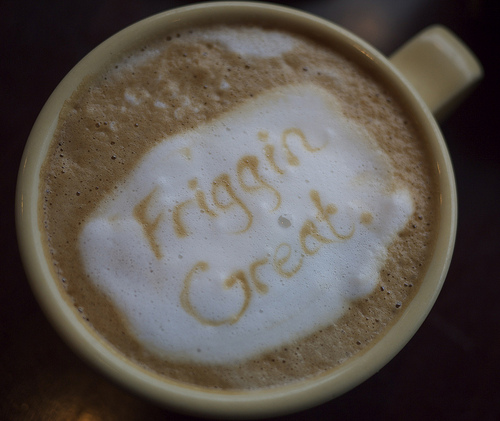
Friggin' Great.

General Books/Recommendations

What should I read next?

Um… I don’t know. I just finished Wanderlove and adored it. Actually, I don’t even know what I’m reading next, to be honest. Maybe check out our CEFS favorites page?

What are the main themes in [book name]?

Kid, you’ve got to read the book. I’m not doing your homework for you. 

Where can I download [book name] for free?

  1. Try your library, if there’s one in your area. Some publishers participate in ebook lending.
  2. If you’re a Kindle owner with Amazon Prime, you can also access the Kindle Owners’ Library in which you can access one book for free each month; many of these are self-published books, but there are a number of traditional publishers participating as well. 
  3. Check Books on the Knob for daily deals, including freebies
  4. If you live in a community with a library (not everyone has one, sadly), you can also check out print books for free—the one in my neighborhood actually holds back new releases each week for people who come into the library (Lucky Day Books), so it’s worth actually going in the library too. 
  5. Some ebooks are lendable. If one you want read is, see if a friend will virtually lend you a book for your Kindle or Nook.
  6. Whatever you do, please don’t pirate books. 

What are some books with lots of sex?

That’s probably a question better answered by Rebeca, whose knowledge on that subject is more broad than mine (I’m trying to get her to review the zombie apocalypse polyamorous novel she just read). But, maybe try Victoria Dahl? Her books are a little much for me, but with that said, they don’t have the yucky gender dynamics that can be very problematic. (Yes, this is a very, very common search term.)

What are some books with lots of action/violence?

I’m kind of a wimp when it comes to this subject, but check out our recommendations for my friend Matt in our Book Matchmaker feature. 

I want to read an urban fantasy series with a strong female lead.

Check out these ideas!

Review: Love in the Years of Lunacy by Mandy Sayer

Reading Mandy Sayer’s Love in the Years of Lunacy was almost like reading two different novels. The first was a fascinating look at wartime Sydney, Australia. The second was an odyssey into the implausible. 

Set in 1942, Love in the Years of Lunacy is told mostly from the point of view of eighteen year old Pearl, a bit of a wild-child jazz musician. She plays saxophone in an all-girl band and one night, while playing in an underground club, she meets James Washington, an African-American GI and phenomenal musician. The two quickly begin a whirlwind romance until that is cut short by the news that James is being shipped out to fight in New Guinea. Pearl does something incredibly impulsive/batshit crazy to reunite with James. 

The beginning of Love in the Years of Lunacy introduces its odd narrative structure—one often used in historical fiction that rarely works for me.

In opens with a writer (it’s always a writer—and in this case the writer name-checks the Australian publisher of Love in the Years of Lunacy as his publisher) in modern day discovering a recording of a story told by his aunt (Pearl), instructing him to novelize her story so that it can be shared—these sections are told in first person. Then it switches to the 1940s and is written in third person, but from Pearl’s point-of-view. This is a narrative style that really bothers me. 

I’m trying to look on the positive side. I guess writing this book has allowed me to understand the complexities of [Pearl] and my background better than I ever have before and, by doing so, I begin to understand myself more clearly—a person who’s never felt completely at home…

It wasn’t until I read this book that I was able to really get my head around why this style of storytelling irks me, but I’ve finally hit on it: by framing a story of a historical figure around a contemporary person’s “discovery” it feels as if the main historical story is diminished. Why can’t a historical narrative stand on its own? In this novel there are some small things related to identity that are relevant to the contemporary discover-er, but really, Love in the Years of Lunacy was not better because of those elements. (And, honestly, they kind of troubled me—see my spoiler discussion here.)

I am fairly certain, that if the novel was told in a straightforward manner, I would have enjoyed it far more. 

Regardless of this frustrating structure, I was captivated by Pearl and James’ story amidst that backdrop of wartime Sydney. 

Review: All He Ever Desired by Shannon Stacey

“You are going to dance with Ryan before this party ends. I don’t care if I have to stand on a chair and announce to everybody that he has to dance with you.”

“If you do that, I’ll go to the library on Tuesday and check out every Nicholas Sparks book you have and not bring them back so you’ll have to tell everybody you don’t have any of his books. Forever.”

“You wouldn’t.”

Lauren smiled over the rim of her champagne glass. “Oh, I would.”

There aren’t a lot of Big R Romance writers whose books I’ll buy without a second thought.

For a long time, it was just Julie James, and then I found Shannon Stacey, whose Kowalski books published by Carina Press absolutely charmed me with their warmth and width. More recently, I discovered Molly O’Keefe and Ruthie Knox who both have distinctive (and quite different) styles. So whenever one of these writers releases a new book, I usually snatch them up ASAP. 

Unfortunately, I was disappointed with the fourth book one of my go-to author’s, Shannon Stacey, Kowalski series about a boisterous New England family, which shifted the setting of the series from New Hampshire to Maine. I was worried that the magic of the first three books couldn’t be rekindled. Fortunately, I gave this series another shot and very much enjoyed All He Ever Desired, the fifth Kowalski novel. 

Ryan Kowalski left his hometown of Whitford, Maine after confessing his love to his best friend’s wife and being rejected. He has since married and divorced and built a successful career for himself in Massachusetts, but returns to Whitford to help his brothers refurbish the family inn. Lauren, the woman he begged to come with him years before is now divorced with a teenage son. 

Ryan discovers Lauren’s son Nick vandalizing the inn and rather than force Lauren to pay for the damage, he makes Nick work at the construction site. And, it provides him a convenient reason to see a more of Lauren, the one that got away. 

All He Ever Desired centers around the theme of “what if.”

List-O-Rama: Eleven Memorable Settings

I read two great blog posts this week about the idea of setting. 

The first was from the ladies at The Readventurer who put together a fantastic post about settings from books they’d most like to visit. There are some awesome ideas—though most of them terrify me because I am not adept at hand-to-hand combat (or any other combat, if I’m going to keep it real). The second great post about setting was from Molly Backes who wrote a guest post on Stacked about the importance of setting in contemporary young adult fiction

Both posts got me thinking about setting in books and what works for me and what doesn’t—and why some books have such memorable settings, sometimes even overshadowing the characters and plot. And my conclusion is that when setting is strong and memorable, the place almost serves as a character itself. Think about Dillon, Texas in the Greatest Television Show Ever aka Friday Night Lights. The characters would not be who they are if they didn’t live in Dillon—and when they leave Dillon, they’re transformed too (i.e., Tyra and Jason). 

Earlier this year, I went up to Seattle for an event featuring Stephanie Perkins, Gayle Forman and Nina LaCour. Stephanie said something that’s stuck with me, that (I’m paraphrasing) she thinks about character first, setting second and plot last. As a reader, that’s the order I think about books too. I can’t buy into a plot if the first two don’t work.

Here are a few books or series with memorable settings.

The Mercyverse - Mercy Thompson; Alpha  & Omega Series
Author: Patricia Briggs
Setting: Pacific Northwest (Tri-Cities, Washington) & Rural Montana

I love the world Patricia Briggs created over seven Mercy Thompson books, numerous graphic novels and three books in the spinoff Alpha & Omega series. What strikes me most is that Briggs has taken a very ordinary place and made it quite extraordinary with an eery underworld. When the books shift to Montana for the Alpha & Omega series, the deep cold woods of the region looms large. 


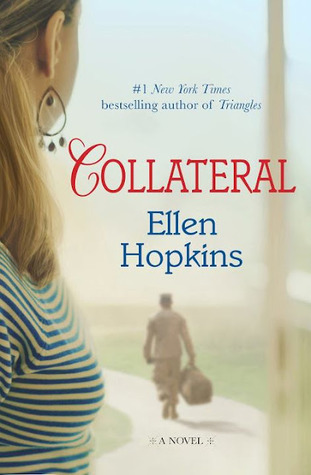
Review: Collateral by Ellen Hopkins

[…] Service. Sacrifice.
      The problem with that being,
              everyone attached to those
                    soldiers must sacrifice, too.
So, as some Afghani warlord
might say,
      put that in your 
             pipe and smoke it. Okay, that
                      was actually my grandpa’s saying.
But it works, and what I mean
       is, think long and hard before
              offering your heart to someone
                      who can only accept it part time. 

It’s fitting that Ellen Hopkins’ newest novel-in-verse for adults, Collateral, shared its release day, November 6, with the United States election day. 

It’s both timely in its exploration of the effects at home of the country’s long-time military involvement in Afghanistan and Iraq and in that Collateral also touches on a number of other current issues in this country, creating a heavy-handed, though still beautifully written, snapshot of American life that’s intertwined with the modern military.

Written in free verse, Collateral is mostly told from San Diego student Ashely’s point-of-view. She meets and falls in love with a Marine, Cole, a guy from rural Wyoming whom she is shocked to discover isn’t what she thought of as the stereotype of a military man.

You can tell a lot by the way
        a guy kisses. Cole kissed like

summer rain—barely wet,
          the temperature of August
              sky, thunder-punctuated. Delicious. 

Cole writes poetry, he’s smart, he’s funny. Their relationship is intense, and Collateral spans five years and four of Cole’s deployments.

The title of the book—Collateral—demonstrates the main theme of the book: collateral damage.

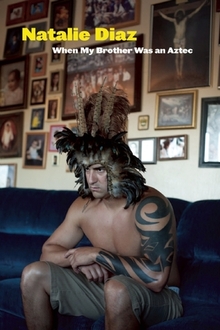
Review: When My Brother Was an Aztec by Natalie Diaz

“A lot of the images that I’ve grown up with, that’s kind of how I filter the world, through those images, and images carry meaning for me. A lot of the words I use – that’s the way we talk here [Fort Mohave Indian Reservation], that’s the way I’ve learned to express myself or at lest to try to express myself.”

Hearing these words from Natalie Diaz, author of When My Brother Was an Aztec, in an interview on public radio, immediately caught my attention.

Diaz discussed work she is doing on her Native American reservation to preserve the Mojave language that is threatened by extinction in the overarching present. The subject of language preservation as well as a discussion of When My Brother Was an Aztec, held my rapt attention.

Diaz pointed out when asked about her sense of identity as a Mohave, that her father is Spanish, that she is also Pima and Mohave, and she grew up outside of the Phoenix area. 

We had a little bit of everything in our house.
 

Diaz discussed her passion for writing as a “sense of hunger” within her, her love of basketball, of how basketball became a way to quiet her life – at least somewhat, and the pain of her brother’s meth addiction and how it affected her family altering or nearly wrecking its structure.

Her intelligence and  passion for her writing and diverse culture led me to purchase her 2012 book of poems and vignettes, When My Brother Was an Aztec. This slim 100 page volume holds beauty, sorrow and celebration. It’s not a quick nor an easy read, but it is well worth a commitment to reading it. 

I could not read this small book of poetry for a sustained period of time. The intensity of each piece does not invite a quick turning of the pages.

Rather, When My Brother Was an Aztec insists on quiet contemplation.

Mini Reviews: Retellings Edition

Retellings of classics are generally hit or miss for me. I haven’t figured out the sweet spot for me, because sometimes I like very faithful retellings and sometimes I like retellings that veer far from the original. I’ve recently read a few retellings and they’ve been all over the map. 

Interestingly, when compiling these mini-reviews, I started looking at Goodreads lists of retellings and it struck me how limited the spectrum of retellings really are. There are loads of Jane Eyres (um… and quite a few naughty versions) and a number of Jane Austens, but really, there’s not a broad range. I don’t know if I’d like to see more retellings, but if it’s something that’s going to continue as a trend, I’d love to see adaptations take on a broader swath of source materials.

Jane by April Lindner on Clear Eyes, Full Shelves

Jane by April Lindner

{Original: Jane Eyre by Charlotte Bronte}

And he left me to dreams that were anything but sweet.


I likely would never have read April Lindner’s adaptation of Jane Eyre if if hadn’t been for Angie’s enthusiasm for it. This is a very modern version of the source material (Rochester is an aging rockstar name Nico), but it’s also extremely faithful to the original story. The relationship between Nico and Jane should have really bothered me because it, like in the original, is not particularly functional. However, also like in Jane Eyre, the story is creepy and atmospheric. I do wish that Nico/Rochester’s Big Secret had been modernized to the extent that the other elements of the story were, because it did read as quite implausible. 

{Amazon | Goodreads}

List-O-Rama: 8 Reading Confessions

We try to maintain the guise here on Clear Eyes, Full Shelves that we’re Extremely Intelligent Individuals. But, I’ve got a few confessions that will blow that image right out of the water.   

Clear Eyes, Full Shelves: 8 Reading Confessons - I didn't finish the Harry Potter series.

#1 I didn’t finish reading the Harry Potter series.

Renegade almost threw her pie in my face when I off-handedly mentioned this to her awhile back. There’s no particular reason for this, except that was an actual adult when this series came out and I started reading and then got busy with life and didn’t finish. I think I left off around book five. I should probably finish reading them, but I’ve seen the movies, so (assuming the storyline follows the books) I kind of know how everything shakes out. 

Clear Eyes, Full Shelves: 8 Reading Confessions - I never read Lord of the Rings

#2 I’ve never read Lord of the Rings.

(Or any of the associated books.) Nor have I seen the movies. I’ve never had any interest. I think I read a couple of pages of The Hobbit when I was around 13 and was all, “What the hell is a hobbit?”

Clear Eyes, Full Shelves: 8 Reading Confessions - I don't read fantasy, even Finnikin of the Rock by Melina Marchetta

#3 Related: I actively avoid reading fantasy.

I adore urban fantasy. However, straight-up fantasy just doesn’t work for me. Once swords, castles and the like come into play, I lose interest. This extends even to some of my favorite authors. I made a valiant effort to read Melina Marchetta’s fantasy series, and I think I only made it through a chapter. I am currently fretting over the fact that the Daughter of Smoke and Bone sequel sounds a lot like a fantasy novel, instead of the very cool urban fantasy of the first book. I will be inconsolable if this is the case. 


Review: Stolen: A Letter to My Captor by Lucy Christopher

You leaned back onto your elbows. As the sun set farther, the colors became vivid. A red washed over everything, brightening the darker sections in the painting. Shafts of light lit up the floor, illuminating the millions of pained dots and flower petals there. Red and orange and pinks intensified all around us, until it felt like we were sitting in the middle of a burning pit of fire … or in the middle of the sunset itself.

Review - Stolen: A Letter to My Captor on Clear Eyes, Full ShelvesI tried to settle in to sleep one evening but could not bring myself to float into dreamland, so I reached for my usual curative: a good book. The first pages of Stolen: A Letter to My Captor did nothing to bring me into restfulness. 

Lucy Christopher’s novel in the form of a letter is written by the captive Gemma to her abductor. In her letter she describes a painting created by her captor on fire with life, separating him somewhat from his foul actions. Flowing from the memories Gemma holds, her experience becomes more than a story of abduction. In most books of this type, an abductor comes clothed in shades of black with little room for anything other than evil intentions, while the abducted is swathed in innocence all white and airy.

However, Stolen offers layer upon layer of complexity.

List-O-Rama: 7 Spooky Reads for Halloween

I am a tremendous wimp. So it really doesn’t take a whole lot to scare me. As a result, I tend to avoid anything that’s too scary or creepy because I don’t have the fortitude for it. 

But, in getting in the spirit of Halloween (because I am most definitely not dressing up), I thought I’d share a few of my recommended spooky or just plain scary reads. 

Summoning the Night by Jenn Bennett (Arcadia Bell #2)

Summoning the Night by Jenn Bennett (Arcadia Bell #2)

This is the second in my new favorite Urban Fantasy series—I chose this one instead of the first book because 1) it’s way scarier than the first and 2) it takes place during Halloween. It also gives you a great excuse to read the very awesome first book in the series, Kindling the Moon. 

{CEFS Review | Amazon | Goodreads}

Texas Gothic by Rosemary Clement-Moore

Texas Gothic by Rosemary Clement-Moore

I recommend the hell out of this standalone upper-YA novel about a teenage witch. It’s a bit spooky, but not terrifying, and is also pretty darn funny. It’s a great choice for lightweights like me. Also, it’s features a completely fun rural Texas setting that I really enjoyed. (I have such a fondness for Fake Texas, as we know.)

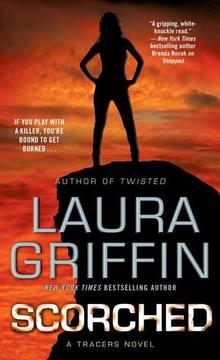
Review: Scorched by Laura Griffin

Scorched by Laura Griffin

In Laura Griffin’s Tracers series—like in the television series 24, which I enjoyed—practical considerations are unnecessary. In the Tracers world, domestic terrorists drive MINI Coopers, anthropologists defuse bombs and everyone is terribly attractive. 

Scorched is the sixth book in the Tracers series, which follows employees of a top-notch private crime lab in Texas. The series has featured hackers, scientists, sketch artists, cops, criminal investigators, writers and FBI agents who all work to solve crimes while simultaneously finding true love.

Yes, Laura Griffin’s Tracers books are as awesome as they sound. 

Admittedly, this latest installment isn’t my favorite because it marks a distinct departure from the previous novels which focused on local crime-solving and veers toward stopping a terrorist plot (in addition to solving a local crime—it’s complicated). However, it still features Griffin’s trademark fast-paced writing and capable, tough characters.  

Scorched features forensic anthropologist Kelsey Quinn at the Delphi Center, where she focuses on identifying bodies. While on a dig in The Philippines, where she’s investigating a mass grave, Kelsey discovers a body that’s buried separately from the others, one that’s had facial reconstruction and appears very out-of-place for a remote Asian island. Suspicious, she takes samples and sends them to her former fiance, Blake, who works for the FBI. 

Upon her return to the United States, Blake asks Kelsey to come to his apartment because he has information about the evidence she collected oversees. Except when she gets to his apartment, Blake is murdered and Kelsey is a witness and on the run. And because she fled, she’s also a suspect. 

Kelsey suspects that law enforcement is involved in a larger conspiracy related to Blake’s murder, and turns to her ex-boyfriend Gage, a Navy SEAL who worked for her uncle Joe. This is where I was a bit confused—I’d not realized that Griffin has published a novella featuring Kelsey and Gage, Unstoppable, and that provides much of these characters’ backstory.

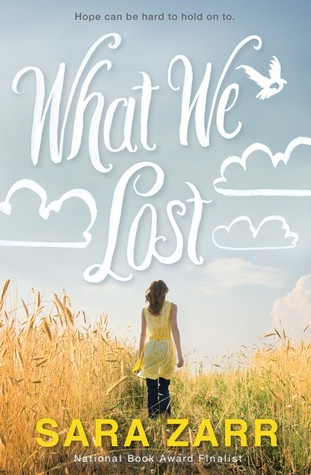
Review: Once Was Lost by Sara Zarr

It’s like a Venn diagram of tragedy.


Once Was Lost by Sara ZarrA perfect flower graces the cover of Sara Zarr’s Once Was Lost. Its soft pink petals top a long, graceful stem. One perfect petal drifts from an otherwise unmarred blossom like a tear falling to the ground.

Blemished  perfection symbolized as a lone teardrop perfectly represents Sam’s life.  Samara, Sam to her family and friends, lives in a cushioned and beautiful world of her family’s creation. Her father’s a pastor, her mother’s a lovely woman, active in her church and liked by her peers.


Yet, a darker side coexists within this dubious heaven.

Fifteen-year old Sam’s secure life in small town Pineville shatters following two events. First, her mother’s DUI lands her in rehab for  alcohol addiction. While Sam struggles with the pain of her mother’s illness and absence, she grapples with embarrassment when asked about when her mother will return; worse yet, she’s confused by father’s unwillingness to be forthright with his congregation about the reason for his wife’s absence. Sam’s appalled by what she perceives as an inappropriate relationship between her father and the attractive and lively youth minister, Erin.

The "New Adult" Category: Thoughts + Questions

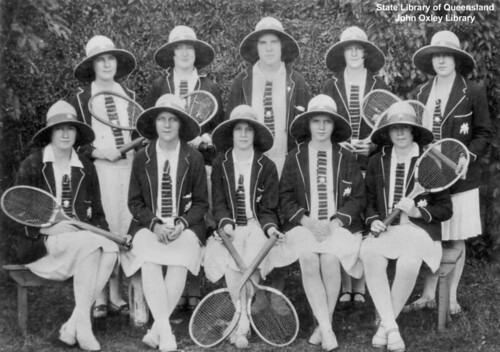
Portrait of St Mary's College tennis team, Charters Towers, Queensland

Nearly every week this summer we saw news of a self-published author’s “new adult” novel’s acquisition and reissue by a mainstream publisher, setting off a flurry of speculation that “new adult” is the next big thing. This was further bolstered by three digital-first imprints or publishers putting out the call for submissions in this category.

Significant publishing deals and emerging publishers seeking out “new adult” titles aside, I’m not entirely sure that it really is the next big thing—or that an entirely new category is even necessary.

The term “new adult” first emerged in 2009 when St. Martin’s Press hosted a contest searching for manuscripts featuring protagonists in the 18 to mid-twenties age range. It was touted as

…fiction similar to YA that can be published and marketed as adult—a sort of an “older YA” or “new adult.”

In essence, it was a response to the phenomenon of adults reading teen fiction and a search for a method to best capitalize on that audience that discovered young adult fiction. Ultimately, St. Martin’s declined to acquire any of the manuscripts they received as part of the contest; two finalists were later acquired by other publishers in the young adult category (Girl of Fire and Thorns and The Treachery of Beautiful Things).

Fast-forward three years (and I think this timing is significant), ebooks have gained meaningful marketshare—14 percent of units sold in 2011 versus four percent in 2010 (with genre fiction, notably romance, often exceeding the average) and self-publishing has become more normalized. Books like Easy (which I recommend), Slammed, Beautiful Disaster and Flat-Out Love are self-publishing “new adult” success stories, and are all now published by traditional publishers. Each of these books tells a story of an older teen and are considered “edgier” that typical YA fare (I do not agree with this assessment, however—there’s a wide range of edginess in the teen market). 

All signs point to “new adult” becoming a full-fledged fiction category, right? 

Well, I don’t know. But, I have some questions. 

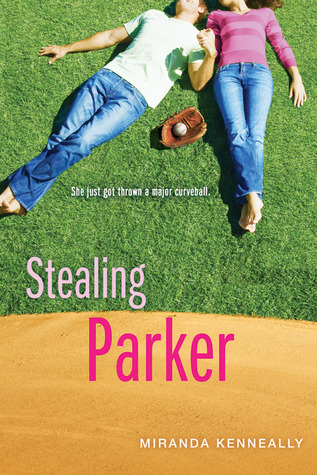
Review: Stealing Parker by Miranda Kenneally

Stealing Parker by Miranda KenneallyI am not one to seek out books I know I won’t like—that’s not how I roll. Despite that my negative reviews generate more pageviews and more comments, I have zero interest in reading things that don’t appeal to me. There are far too many books in the world to waste my precious reading time that way.

As a result of that, I know some of you will be surprised that I read Stealing Parker after Miranda Kenneally’s debut, Catching Jordan was a quick “did-not-finish” book, due to its ridiculous implausibility and extremely troubling themes. 

Nevertheless, I couldn’t resist trying Stealing Parker, as I am desperate for a quality sports-themed read and I’ve grown to adore baseball. (Guess who saw a perfect game—in person—this summer? That’s right, this girl!) Unfortunately, while I did finish Stealing Parker, it was a struggle. I am certain many readers will enjoy in this book, but for me it was too shallow and too inauthentic to recommend.

Seventeen year-old Parker is a former high school softball star who quits the team, loses 20 pounds and starts kissing inappropriate boys after her mother announces she’s a lesbian and moves away to live with her girlfriend. Her mother’s news scandalizes Parker’s conservative small town and particularly Parker’s family’s church community.

In this slim novel, Kenneally attempts to tackle all of the issues Parker faces, including crises related to faith, family and friendships—not to mention Parker’s extremely ill-conceived flirtation and eventual relationship with the baseball team’s new assistant coach.

The storyline about Parker’s strained relationship with her mother and the resulting fallout in the family’s community is the most compelling and authentic.

This news rips apart Parker’s family, and in her conservative small town people are quite unkind and my heart sort of broke for Parker as she feels so very lost as her old friends push her away and her family crumbles.

The day Laura told everyone I was probably just like my mom— a butch softball player who probably likes girls— Drew crawled into my bed and held me until I cried out every tear in my body. He held me all night long. Even with everything that’s happened to me, I have to thank you for letting me keep Drew. Written on February 17; kissed and tucked away in my Bible.

Unfortunately, this is only a small piece of the main storyline—it pops up here and there when Parker reflects on her attempts to be a better girly-girl (she spends a lot of time tangling her hair in a specific way that is apparently very appealing to teenage boys), and the end of the book deals with her reconciliation with her mother—but that’s not the meat of Stealing Parker.