Mini Reviews: Three DNFs from Rebeca

I used to be a die-hard, must-finish reader. If I started a book, by God, I would finish it--even if it made my eyes bleed.

These days I’m much more relaxed; if a book doesn’t speak to me I don’t force myself to finish it. Since I started school again full-time I’ve had less reading time and even more DNFs to my name. These are a few of the books that I’ve abandoned over the last few months.

(Keep in mind this may say more about my own reading habits than about the quality of the books themselves.)

Thief of Shadows by Elizabeth Hoyt

I love fairy tales and re-imagined stories of all kinds.

Elizabeth Hoyt’s The Princes Trilogy, a series of historical romances with fables woven into them, is right up my alley and I’ve become a fan of her work. While I haven’t enjoyed her Maiden Lane series quite as much I was still excited to read the fourth installment, Thief of Shadows.

This book follows Winter Makepeace, headmaster of a home for foundling children who is also secretly a Batman-style vigilante named the Ghost of St. Giles. When he is rescued by Lady Elizabeth Beckinhall after another close brush with death he struggles to protect his identity from the lonely society widow.

Review: Ultraviolet by R.J. Anderson

I realized then that even though I was a tiny speck in an infinite cosmos, a blip on the timeline of eternity, I was not without purpose.

Once upon a time there was a girl who was extraordinary. She could hear colors, and see sounds, and taste the difference between truth and lies.

Let go of your preconceived notions of reality. Then imagine a new reality, one where you hear colors, taste words and see sounds. You understand your sensations exist on a plane that others do not experience, so you cloak yourself in a garb of false normalcy hiding your true self and your understanding of the world from others. Even love has a unique flavor and sound only you can know.

When the music stopped, I'd been afraid even to look at him, sure he could hear my rapid heartbeat as clearly as I could see his steady teal-green one. When he'd slid away from me and gotten up, the wanting inside me had ached so hot that I'd had to stifle a whimper. Inwardly I'd berated myself, not just for feeling more than I should but for coming so close to sowing it.

At sixteen, Alison's life has turned into a nightmare.

R.J. Anderston creates a portrait of extraordinary senses in Ultraviolet beginning with her awakening in a mental institution where she pieces together her tangled memory to discover what occurred to bring her there. She's stunned by her condition, by the yellow-gray stink of sweat surrounding her. She believes her worst nightmare as become her present reality.

She's gone crazy. Alison is sure of it. Her mother has locked her away.

List-O-Rama: Celebrating 8 Difficult Female Characters

Challenging, difficult and unlikable characters are a funny thing. When they're done well, they make for some of the most memorable characters in books. 

However, they're often misunderstood as readers tend to want characters to whom they can relate, and no one wants to admit to related to someone who's well, kind of a jerk. It's even tougher for female characters, whom are often held to higher standards than their male counterparts (a subject I intend to write about eventually).

So, I thought I'd use this week's List-O-Rama post to give a shout-out to some of my favorite challenging female characters.

Every character in every book by Courtney Summers. (YA)

Namely, Sloane from This is Not a Test and Regina from Some GIrls Are. These two girls are definitely people people I would not want to hang out with--and neither would even think of letting me be their friend. But Summers is such an adept writer that she makes me care about these girls and want things to be okay for them. I wanted Sloane to want to survive the zombie apocalypse; I wanted mean girl Regina to triumph over the other mean girls. 

This is Not a Test on CEFS / Amazon / Goodreads 
Some Girls Are on Amazon ($4 paperbacks!) / Goodreads

Review: Uses for Boys by Erica Lorraine Scheidt

Sometimes the idea of a book is ultimately stronger than the story within.

In the case of Erica Lorraine Scheidt's debut novel, Uses for Boys, I found myself distracted by the innovative take on teen sexuality. However, once I was stuck into the story, the execution ultimately did not work. 

Uses for Boys opens when Anna, whose first-person point-of-view is told in a stream-of-consciousness, real-time style, is a child, alone with her mother, never having known her father. She believes that, together, she and her mom can take on anything. But soon, a string of stepfathers and a career mean that Anna rarely sees her mother, she believes she has no family.

I want to go back to the tell-me-again times when I slept in her bed and we were everything together. When I was everything to her. Everything she needed.

She soon discovers that boys can make her feel needed, that they can fill a void for her. The attention makes her feel special, even if it means that the girls shun her and call Anna vicious names. 

The first few chapters of Uses for Boys make for powerful stuff.

The perspective of young Anna as she decides to allow herself to go down the path of allowing boys to use her, to abuse her, is heartbreaking. She eventually starts playing house with a boy every day and they become sexually involved. This makes her feel important and grown up. This boy needs her in a way her real family never did.

Of course, it's all just a fantasy and it doesn't last.

And then he doesn’t say anything. He doesn’t say he’ll miss me or that he’s sorry. Does he know he’s leaving me? That I’ll have to ride the bus home alone and come home alone and be home alone? They leave, I think, just like my mom says.

Links + Things: Algonquin's Young Reader Imprint, The Fringe Book and a Year of Verse Novels

This week, I have a bunch of interesting news, ranging from an intriguing new young adult and middle grade imprint and a free download of one of my favorite light-hearted romance novels.

Links

Algonquin Launches YA/YR Imprint (Facebook)
Algonquin Young Readers, launching Fall 2013, is a new imprint of Algonquin Books dedicated to publishing works of the same literary merit and enduring qualities that are hallmarks of the Algonquin tradition.

Algonquin Books has released some interesting and well-performing fiction in the last few years (including the Water for Elephants), and this week they announced that they're launching an imprint focused on middle grade and young adult titles, Algonquin Young Readers. This is pretty intriguing, and it sounds like they're taking a literary approach to their acquisitions (they're posted on their Facebook page, linked above). 

The one that piques my interest the most is Sara Farizan's If You Could Be Mine, which is about a lesbian teen in Iran, where being gay is punishable by death. (There's a preview up on Scribd.)

I'm excited to see where they go with this imprint, since I do think there's a market for more literary-minded books for young people.

Review: Unsticky by Sarra Manning

“We're broken. It's like we have all these jagged edges that scare other people off, but when we're with each other, our jagged edges fit together and we're almost whole.”

On paper, Sarra Manning's Unsticky has all the trappings of a novel I should hate: a wealthy man; a desperate, naive young women and an outlandish scenario throwing the two together. 

And yet, it came highly recommended by Angie, whose taste is excellent and is very similar to my own. (also excellent) taste. And where other books with similar plots enrage me, Unsticky enthralled me. I lost sleep and fought through weary eyes to get through this captivating 550-page novel.

Grace is a recent almost-grad (there was an incident at her senior show that prevented her from actually graduating from college) who partied too hard, hooked up with too many losers, is drowning in debt and working in a dead end job at a fashion assistant at a magazine where she seems destined to never get her shot.

At one of her lowest moments, Grace meets Vaughn, an older--extremely wealthy art dealer--who has an intriguing, and disturbing proposition for her: in exchange for thousands per month, she'll be at his beck and call, host his parties, and be his arm candy whenever she's needed. Desperate for cash and in need of something--anything--different in her life, Grace signs a six-month agreement and she's quickly drawn into Vaughn's world of privilege and society.

Sound familiar

Actually, Unsticky isn't what you think.

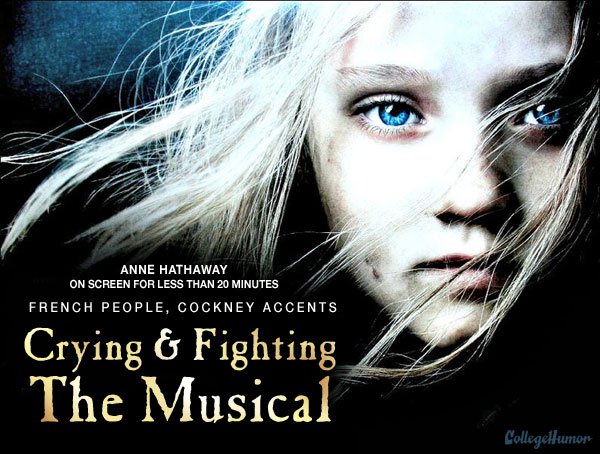
Les Miserables, "Snark Cap" Edition

A few weeks ago, Sarah and I went to see the recent film adaptation of Les Miserables and came away less than impressed.

Apparently, we’re the only ones who feel that way because everyone else on twitter won’t stop talking about how the movie made them feel ALL THE FEELZ.

To top it all off, not only did it win three Golden Globes, it’s also inexplicably been nominated for eight Academy Awards. Has a non-silent movie with no spoken dialogue ever been nominated for that many before????

To alleviate how very miserable (hardy-har-har) the unwarranted hype of Les Miserables has made me, I have generously put together a snark-filled recap for anyone who has not yet seen the movie.

To ratchet up the amusement factor, I strongly suggest reading the provided “dialogue” with a sing-song voice.

Opening Chorus

The fact that this story takes place in France has no relevance! 
We all know this is a movie filmed during the 21st century financed by a British production companyyyyyyyyy! 

So we will all wear our British and Aussie accents proudly and not bother trying to sound like Frenchiiiiiiiiies! 

List-O-Rama: 6 Upcoming Grown Up Novels

2012 was a bit disappointing for me in terms of adult fiction, with the exception of a couple of great genre reads. Optimist that I am, I'm hoping that 2013 will be better.

Here are a few that look promising. *crosses fingers*

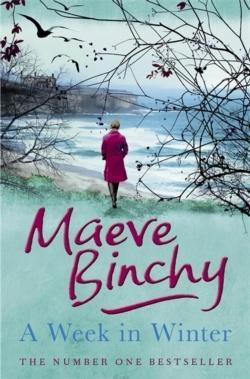
A Week in Winter by Maeve Binchy (U.S. Release: Feb. 12, 2013)

A Week in Winter is beloved Irish novelist Maeve Binchy's last book, which she completed shortly before her death last year. It's already out in the U.K. and Ireland and has gotten some very positive reviews. I received an ARC of this one, and am looking forward to reading it soon. (I do prefer the U.K./Irish cover, though--it looks less dour.)

Amazon / Goodreads

He's Gone by Deb Caletti (May 7, 2013)

I have really enjoyed Deb Caletti's young adult novels, and I think he style will be well-suited for an adult novel. He's Gone sounds like it has a bit of mystery to it, which really intrigues me, since her YA novels tend to be family drama-type stories. I'm really digging the cover, too. 

Amazon / Goodreads

Links + Things: Alpha A-holes, Book Marketing and Delayed Ebook Releases

One of the reasons I wanted to update my content management system is because I am constantly clipping links and other interestingness in Everynote that I want to post on the blog, but I didn't have an efficient way to do so. The new setup makes this so much easier, so I'll be doing posts about interestingness I've found more regularly. 

Today's topics: the return of the asshole alpha male character, marketing saturation and delayed ebook releases.

Links

What's old is new again - the Alpha-Ahole (Drunk Writer Talk)

In real life most women I know wouldn’t walk but would RUN from this man. But romance isn’t real life and there is no shame in liking what you like. We just have to hope that all this testosterone is sometimes countered with books about incredible women. Because I want to read her story too.

Cover Chat: Hooked by Liz Fichera

Earlier this week, I reviewed (and recommend, with reservations) Liz Fichera's debut novel for teens, Hooked. However, I keep coming back to the cover--it just doesn't work, in either the U.S. or Australian edition.

Three things lingered with me after I finished reading Hooked:

  1. It's not a romance;
  2. Setting is almost a character in and of itself; and
  3. It's a rare YA novel in that it really got the "feel" of sports right.

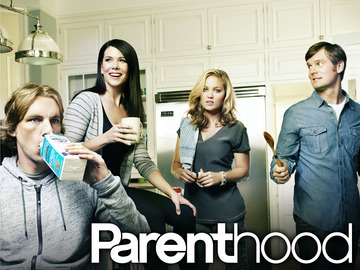
55 Thoughts After Watching (Nearly) 4 Seasons of Parenthood

Welcome to another episode of Sarah's Netflix Binges! Up next: Jason Katim's post-Friday Night Lights vehicle, Parenthood. 

I fought watching this show for, well, the entire time it's been on. Then, I got really bored in December because I wasn't teaching and didn't have any work projects lined up, so I did what any red-blooded America would do and watched a ton of television. Finally, I'd run out of options, realizing that I really had a problem if I was thinking watching season three of Friday NIght Lights for the tenth time was a viable option, and queued up Parenthood on the Roku.

(Unpaid endorsement: I ♥ our Roku so much--it's up their with our SodaStream on my Official List of Things More Awesome Than They Seem Like They Should Be.)

Naturally, I have some thoughts...

Overhaulin'

As I've mentioned a time or a thousand, I've been working on revamping the functionality of Clear Eyes, Full Shelves so it will work better with some of the Very Cool Things we have kicked around to add to the blog.

So, I've launched the site on a new version of our existing content management system in hopes that the third time's a charm. *fingers crossed* 

Hooked by Liz Fichera - a review on Clear Eyes, Full Shelves

It’s been well-documented that I’m on a quest for a quality sports-themed young adult novel, particularly one with a female main character. 

Unfortunately, much of the time my enthusiasm for the newest sports book is immediately tempered by the sports serving as mere window dressing to bring the protagonist together with a Very Attractive Boy. 

But I keep soldiering on, seeking one of these stories that really works. However, I almost passed on Liz Fichera’s debut, Hooked, which features a Native American girl in Arizona who makes a splash with her golf mastery while negotiating a burgeoning relationship with a boy on her team (I haven’t had great luck with Harlequin Teen titles). But, a short interview with Liz on Stacked piqued my interest and I thought I’d give it a try, and despite some flaws, it was a surprisingly compelling read.

Fredricka (Fred) Oday lives on the Gila reservation, which abuts the city of Phoenix, Arizona. Like many kids growing up on the reservation, Fred’s options after graduation are pretty limited. Except she’s got something special going for her: a killer golf game. She learned to play because her father works at the golf course. Over the years, she’s excelled to the point that her high school’s golf coach adds her to the boys varsity team (there isn’t a girls team). 

However, despite her phenomenal skills on the golf course, she’s not welcomed with open arms. A player with a bad attitude and mediocre game, Seth, is removed from the team to make a space for Fred and the boys aren’t happy. They’re furious that a girl is on their team, but they are even more upset about a girl from the reservation on their team that replaced their buddy.

Then my eyes lowered to my seat, the empty one at the front of the row. There was a folded newspaper waiting on my desk, maybe the same one that Ryan had shown me in the library, and my stomach somersaulted all over again. Quickly, I placed my backpack underneath my desk and slipped into the seat. My smile faded when I found the photo on page three of the sports section, the same one where I was holding my driver on the fourth tee. Someone had used a black marker to draw a band around my forehead with feathers on each side. A crude Indian headdress. My nostrils flared and my breathing quickened. The photo turned cloudy the longer I stared at it. I had to swallow back the bile building deep in my throat. I folded and then crumpled the newspaper and stuffed it inside my backpack. I wanted to shred it into a million tiny pieces.

Despite the tensions among teammates, there’s chemistry between Fred and Ryan, the team’s other top golfer with whom she’s paired at tournaments. 

Told in alternating points of view from both Fred and Ryan’s perspective, Hooked explores all of these tensions against a backdrop of the American southwest.

Gone Girl by Gillian Flynn: Horrible People Being Horrible - a review on Clear Eyes, Full Shelves

You probably know by now that I love a good thriller, so I bought Gillian Flynn’s much-buzzed Gone Girl with high expectations.

It’s received high praise, been lauded as a frightening portrait of psychopathy that’s brilliantly-written with twists and turns to rival Alfred Hitchcock. Glowing reviews snagged my attention and I bought it despite Sarah’s warnings that it may not be my sort of thriller.

A seemingly perfect, beautiful wife who is well-known as the template for a series of children’s books titled “Amazing Amy” and a husband, Nick, who’s become disillusioned with his life and his wife give some backbone to the claim that this suspense thriller will chill and thrill its readers. Amy and Nick Dunn finds them living where neither wants to be with no income other than Amy’s money from her parents who are as wacky and unlikeable as all the other characters in Gone Girl. In a rented McMansion along the Mississippi River they bemoan their fall from a life of luxury in New York, loss of jobs and their loss of passion for one another. Into this mix comes Amy’s disappearance on what should have been a celebration of their anniversary. 

This bland, yet strangly intriguing, plot concept could be viable, but it fell apart for me thanks to Gone Girl’s wholly despicable characters.

Amy aka Amazing Amy made her parents a great deal of money. They patterned her actions, her relationships with her friends, even her appearance into a series of books that found their way into grade school classrooms, libraries, bestseller lists and finally into the hands of nearly every child in the U.S.  But shocking as it becomes for the country, Amy the icon disappeared leaving her husband as the  prime suspect for her disappearance. Suspicion of murder becomes stronger with each weird clue that surfaces.

The first section of Gone Girl centers around the investigation into Amy’s disapearance. We discover that Amy is a mean-spirited, manipulative creature whose sole purpose is to make others miserable, to condemn everyone she comes in contact with and to sharpen her killer instincts with each ugly action she takes. Amy has plans and wickedly ugly and cynical thoughts to condemn anyone unfortunate enough to fall under her spell.

Getting into the mind of a person with no redeeming qualities does not make for an enjoyable read. 

Reawakening by Charlotte Stein - Reviewed on Clear Eyes, Full Shelves

It has recently come to my attention that Clear Eyes, Full Shelves has been pigeonholed as a YA blog—while simultaneously being blocked from several servers for indecency.

WTF? How dare they constrain us to simply a single category? We’ve got our own official adult romance correspondent! We review everything from the latest True Blood to Japanese horror novels! And when did chest-waxing become an indecent topic*?

In an effort to really earn that indecency label and prove, once and for all, that we aren’t only interested in YA, I decided to review Reawakening by Charlotte Stein, a book about how the zombie apocalypse forced a one woman and two hot men into a threesome.

Yeah, you read that right. Zombies and the fun kind of threesomes. (You get this is NSFW, right?)

Reawakening takes place two years after zombies have changed life forever. No-one’s really sure what caused the crisis; no-one knows what changed the majority of the population into strange creatures that sure resemble zombies.

‘They’re not even fuckin’ zombies, really- people just went crazy, you know they did. Probably, like, some mutated rabies virus or some shit like that. And I bet it weren’t even a bomb or some kind of chemical warfare. I bet it was something fuckin’ ridiculous, like GM crops or a new kind of Aspirin.’

Civilization has crumbled, leaving random pockets of survivors and a hell of a lot of flesh eating creatures. June has managed to survive the zombie apocalypse (so far) but she’s definitely hurting. She’s rescued in the first chapter by a weirdo in a Hawaiian shirt named Jamie who takes her to his safe island.

Jamie lives on an island fortress, surrounded by mines, alarms and all sorts of weaponry along with his friend Blake. At first June has difficulty adjusting to this new, less dangerous reality. With such an impregnable fortress between them and any danger, Blake and Jamie haven’t had to abandon everything that makes life worth living.

2012 Official List of Awesome

Some blogs have “best of” lists, Clear Eyes, Full Shelves has an Official List of Awesome. 

We’re honoring the reads that were most memorable of the year, using an extremely random scientific methodology. 

Favorite Debut - Something Like Normal by Trish Doller

Nominated by Sarah 


CEFS Review / Amazon / Goodreads

Best Under-the-Radar YA Novel - Miracle by Elizabeth Scott 

Nominated by Sarah


CEFS Review / Amazon / Goodreads

Book That Changed the Way I Think About Romance Novels - Can’t Buy Me Love by Molly O’Keefe

Nominated by Sarah


CEFS Review / Amazon / Goodreads 

Best Paranormal Not Written by Maggie Stiefvater - Unspoken by Sarah Rees Brennan

Nominated by Laura, Seconded by Sarah


CEFS Review / Amazon / Goodreads

Review: Falling for You by Lisa Schroeder

Falling for You by Lisa Schroeder on Clear Eyes, Full Shelves

I hadn’t had many people in my life who made me feel special. You know what happens after awhile? You start to wonder if you matter.

I mean, really and truly matter.

And the more time that goes by, the harder it is to believe that you do.

Lisa Schroeder has quickly become one the select few authors whose books I love to revisit.

The Day Before, her 2011 novel in verse is one of my all-time favorites reads and I often pull it from the shelf in my office (uh, I just realized that “my” of this book is actually Laura’s—whoops!) and read a couple of passages at random. 

Lisa’s books work for me in a way that a lot of contemporary YA novels do not. She talks about families and life and friendship and love in a way that’s universally understandable, regardless of whether you’re 15 or 35 or 55. There’s a thread of goodness that runs through her stories, and each has left me feeling a bit better about the world. None of this is what’s popular and trendy in teen fiction, so her books are a breath of fresh air on the crowded teen fiction shelves. 

With that said, I was admittedly sad when I learned that her 2012 young adult novel, Falling for You, wasn’t a verse novel. I love verse, and Lisa’s verse novels are some of my favorites.

However, after reading Falling for You, I’m actually quite happy that Lisa chose to write this novel in traditional prose because it will allow verse-averse readers to try one of her books and perhaps the numerous poems in Falling for You will be a gateway to her four verse novels. 

Rae is a teen in a small-ish town in Oregon. She works hard at a flower shop, Full Bloom, where her coworkers and the other people who work at the nearby businesses are as much her family as her actual family—perhaps more. She lives in a challenging home environment where money is always tight and made tighter when her stepfather, whose job loss early in the novel creates further financial pressures and tensions in Rae’s household. 

At the same time, Rae quickly becomes involved with Nathan, the new boy at school whose devotion sends off alarms bells for Rae. She quickly realizes that this relationship is too much, too fast and the situation frightens her. Meanwhile, her friend Leo, who’s home schooled and works in his family’s coffee shop near Full Bloom, senses that things are wrong in Rae’s life, and desperately wishes to help her, if only she’ll let him. Leo—whose life has a lot of complications as well—introduces Rae to his hobby of making YouTube videos and his positive outlet seems to subconsciously inspire Rae to take her poetry more seriously. 

These events all happen in the form of extended flashbacks, which make up the bulk of Falling for You. In the present, we know that Rae is injured and in an intensive care unit, clinging to life. Interspersed within both are poems written by Rae which are published in the poetry section of her school newspaper. These poems lend further insight into Rae’s real feelings about her family, her boyfriends, friends and job—through these poems we see the real Rae.

I’m not the floor
to be walked on
or the hammer
to be used.

I’m not the choir
to sing your praises
or the commercials
to be ignored.

I’m the baby bird
wanting to fly
and the orchid
starting to bloom. 

The overarching them in this surprisingly complex and dark story is the tension between darkness and light.

“Yo, padre!” he’d say. He’d challenge the priest about the unscientific impossibility of the miracles and when the priest continued to ignore him, he’d get mad and yell out something about Pope Alexander VI’s bastard children, or Pope Leo X’s hedonism, or Pop Nicholas III’s simony  or the murders committed in the name of the Church during the Spanish Inquisition. But what could you expect, he’d say, from an institution run by celibate men who wore dresses. 

Review: The Glass Castle by Jeannette WallsThese words flowing from the always opinionated mouth of Jeannette Walls’ father made her worship time memorable and short. 

She begins her memoir, The Glass Castle, speaking not of her early childhood memories, but rather of herself as an adult sitting in a taxi worrying about whether she had overdressed for the evening’s events when she spots her mother digging through a dumpster. They’re only fifteen feet apart but in truth, a world of differences separate them. She watches as her mother hoists items from the dumpster, examines them and then laughs with glee at what pleases her. Her mother’s hair hangs tangled, dirty and matted while her eyes sink deep into her face making her sockets look like caves.

Feeling panic rising in her chest, Jeannette slides down into her seat and asks the driver to take her back to her home on Park Avenue. She’s come a long way from poverty, hunger, icicles hanging from the ceiling as she struggles to stay warm. She fears that someone going to the same lavish party as she will spot her if she speaks to her mother. Then her secret would be out for all to see the darkness from where she came.

This memoir struck a chord deep within me.

Ten Wishes for the Year in Reading

I’m not one for resolutions—I completely agree with the theory that goal-setting can actually lead to failure or mediocrity. In fact, the lowest-functioning organizations and people I’ve worked with have all been extraordinarily preoccupied with goal attainment.


I participate in the Goodreads reading challenge for the sole purpose of having that handy count of books read in the sidebar, not because I want to reach a specific threshold. (Though I will admit, two years in a row, I’ve been a couple of books shy of 150 during the last week of the year and have power read through to ensure I have a nice, round number.)

So in the spirit of ignoring the idea of goals, I’m eschewing the reading resolutions posts that abound on the web today and would like to share a bit of what I’d like to see in the upcoming year in reading, publishing and book culture.

#1 An end to the divisive, unproductive, ridiculous discussions of e-reading versus print reading.

Why anyone cares in what format people choose to read books is beyond me, particularly in a culture in which a quarter of the United States population has not read a single book in the last year. Whatever helps ensure people get a book—digital, print or etched in a stone tablet—in their hands is fine by me, and it should be for anyone who truly cares about promoting reading culture. 

#2 An end to the term, “Mommy Porn.”

Thanks to the legion of ridiculous articles about 50 Shades of Grey, “mommy porn” is used to dismiss the reading choices of women by people who are threatened by women reading about S-E-X. I wrote about this early last year and it continues to frustrate me.